
By Luka Okropirashvili
BA International Relations Student at Webster University Georgia
July 2025 • 7-Minute Read
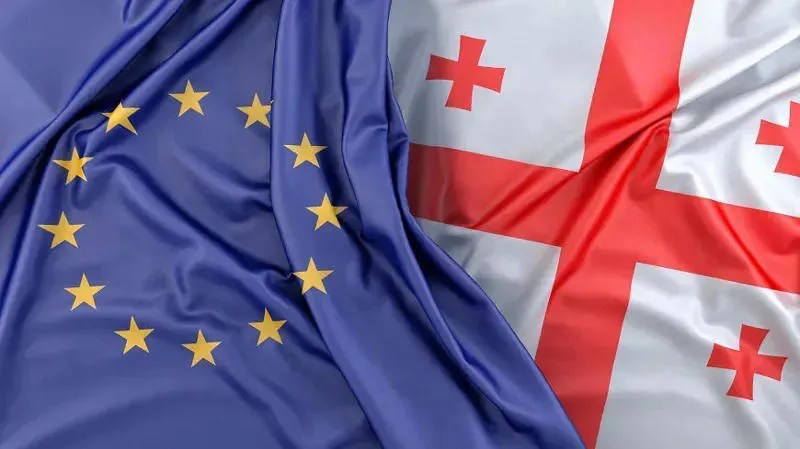
A considerable period of time has elapsed since the historic turning point when the European Union officially granted Georgia long-anticipated candidate status, a principal normative prerequisite for its prospective accession process in the bloc. Against all odds, the voices of the traditionally Western-oriented people of Georgia were heard, and their unparalleled existential struggles were taken into account by high-ranking European bureaucrats, while politically fulfilling historical justice.
In objective retrospect, over the bittersweet history of its bumpy socio-political development and heterogeneous sociocultural transformations, Georgia has not even questioned its strategic geopolitical orientation and the declared choice of civilization – Europe. Georgian-European interactive intracultural ties span millennia, rooted in a continuous process of mutual exchange and historical connectivity, reflecting Georgia’s enduring place within the inclusive European fabric.
It is simply a matter of fact that, in the broader context of both interest-based expectations and strategic stakes are consistently positioned at an exceptionally high level. There is little contestation over the profound symbolic and political resonance that the notion of the “European family” carries for the Georgian public. Yet, even amid such widespread enthusiasm, civic mobilization, and collective aspiration, it is both legitimate and analytically prudent to pose comprehensively critical inquiries: What constitutes the European Union in its contemporary form, and through which historical, institutional, and intragovernmental processes has it evolved into its current configuration?
This is the triumphant story of transformative success and expansive ascent of the defining force of the world order – the European Union.
European Union at Dawn
The genesis of the European Union can be dated to the dramatic post-World War II epoch when, against the backdrop of augmenting humanitarian catastrophe, economic collapse, and annihilated security architecture, European political authorities grasped that anchoring lasting peace and prosperity necessitated intracontinental integration. UK Prime Minister Winston Churchill was a true pioneer in kickstarting this unprecedented strategic venture of European consolidation within the organizational framework of the United States of Europe. Yet, the latter proved to be an impractical and ephemeral initiative, ultimately remaining unimplemented until the launch of the relatively pragmatic and realistic Schuman Plan.
In 1950, French Foreign Minister Robert Schuman delivered the Schuman Plan, proposing the first tangible and politically calculated step toward constructing a unified European rule-based system capable of ensuring long-term peace and stability on the continent. Given the fierce historical rivalry and routinely escalating conflicts between France and Germany, the subtle and nuanced pursuit of Franco-German reconciliation emerged as a top priority in the political agenda and consensual imperative for maximizing prospective harmony and balanced power dynamics across the continent. Coal and steel production constituted a polarizing and unresolved challenge to the pressing process of European normalization. These resources were not only vital for energy supply and the foundational economic functioning of the respective nations involved but were also crucial inputs for military manufacturing industries, further complicating effective and organized operational management. To untangle this sabotaging and destabilizing interest conflict over the Franco-German dilemma, on May 9, 1950, Monsieur Schuman enacted the action plan devised by competent French economist Jean Monnet, laying a foundation for a joint European institution (mandating the collective production of coal and steel, even allocation, and fair oversight). In conjunction with West Germany and France, four other countries, Italy, the Netherlands, Luxembourg, and Belgium, formally endorsed the materialization of the Schuman Plan compromise. (Dinan, 2025)
As a concrete realization of Robert Schuman’s visionary project, the Coal and Steel Community was instituted in 1951 with a central mission of pooling the coal and steel resources of European nations – France, Germany, Italy, Belgium, the Netherlands, and Luxembourg. In the long run, the historic precedent of institutionally forming this major intergovernmental organization, coupled with growing momentum for collective integration, radically reshaped the European sociopolitical landscape. The European Coal and Steel Community progressively transformed into what is known today as the European Union.
A Golden Age of European Rise
On January 1, 1973, three new members joined the European Communities: Ireland, Denmark, and the United Kingdom. The formalization of regular biannual meetings among heads of state in 1974 finalized with the foundation of the European Council. By 1974, Portugal, Greece, and Spain had overthrown domestic dictatorships, ushered in liberal democratic transitions from dismantled totalitarian regimes, and undertaken an ambitious geopolitical course of full-fledged integration into the sovereign European rule. The turbulent 1970s in European political affairs culminated in a groundbreaking shift with the first direct traditional election of the European Parliament, bolstering the practice of intergovernmentalism in the developing union.
Inception of the EU
The status quo of the 1980s ECSC featured prevailing intergovernmental convergence and an increasingly strong institutional reformist drive. In 1985, Belgium, France, Germany, Luxembourg, and the Netherlands signed the Schengen Agreement, initiating the phased elimination of rigid border controls and advancing the principle of freedom of movement for their citizens, as well as for nationals of other Schengen signatories and European countries. The following year, on February 28, 1986, the ratification of the Single European Act marked a significant legal and institutional milestone, de jure incepting the European Council, a court of first instance, and the official renaming of the Parliamentary Assembly to the European Parliament. Throughout the 1980s, Spain, Greece, and Portugal ascended to the EU, further expanding its southern borders. (Chase, 2025)
On February 7, 1992, the Treaty of the European Union, commonly known as the Maastricht Treaty, was signed, formally establishing the European Union as a political and economic entity. Building upon and modifying earlier European treaties, the Maastricht Treaty introduced a three-pillar structure: the European Communities, the Common Foreign and Security Policy (CFSP), and cooperation in the fields of Justice and Home Affairs (JHA). What followed the latter process was the inauguration of the Economic and Monetary Union and a single currency (the euro) by the European Central Bank, and later in 1999, the Eurozone. In 1993, the centralized European market was launched with the “4 freedoms” of free movement (people,
services, services, and money). In 1995, Finland, Sweden, and Austria joined the EU as member states. In response to rising internal governance challenges within the growing Union, the Amsterdam Treaty was signed in 1997. This intergovernmental conference sought to provide a more coherent institutional framework to ensure the EU’s capacity for future enlargement and to facilitate the integration of Eastern European countries into the Union. (Leucht, Seidel, & Warlouzet, 2023)
21st Century EU
The turn of the 21st century, accompanied by emerging global security threats, mobilized European countries to prioritize deeper political and economic integration. Between 2004 and 2013, Romania, Bulgaria, Malta, Cyprus, the Czech Republic, Estonia, Hungary, Latvia, Lithuania, Poland, Slovakia, Slovenia, and Croatia joined the European family. After eighteen years of complex political deliberations and negotiations, and in the shadow of the 2008 global financial crisis, the Treaty of Lisbon was signed, replacing the Treaty of Rome and the Maastricht Treaty as the EU’s constitutional foundation. The Lisbon Treaty induced several key institutional reforms, including the creation of a permanent President of the European Council, the appointment of the High Representative for Foreign Affairs and Security Policy, and the reinforcement of the subsidiarity principle to better balance power dynamics between EU institutions and member states.
As of today, the European Union comprises 27 democratic states, working in coordination and collaboration to contribute to the collective objectives of security, peace, and prosperity for their citizens. The European Union is home to approximately 450 million people across 4.4 million square kilometers of territory. Its fully integrated member states include Austria, Belgium, Bulgaria, Croatia, Cyprus, the Czech Republic, Denmark, Estonia, Finland, France, Germany, Greece, Hungary, Ireland, Italy, Latvia, Lithuania, Luxembourg, Malta, the Netherlands, Poland, Portugal, Romania, Slovakia, Slovenia, Spain, and Sweden. The United Kingdom, a former
founding member, formally withdrew from the EU in 2020. At present, the prospect of enlargement remains cautiously open to several candidate and potential candidate countries – namely Georgia, Ukraine, Moldova, Albania, Bosnia and Herzegovina, North Macedonia, Montenegro, Serbia, and Turkey – each at varying stages of the accession process.
The European Union, with its exclusive institutional and organizational system, proves to be the most successful supranational alliance in modern history. To this day, the EU retains its status as a beacon of democracy, equality, tolerance, solidarity, unity, and transparency. When it comes to Georgia, the EU embodies the pathway towards egalitarian prospects of democratization, the rule of law, liberty, and welfare. At its core, EU membership offers a positive-sum, mutually beneficial opportunity for the Georgian people.
Bibliography
Dinan Desmond. A Concise History of the European Union. 2025. Lynne Rienner Publishers.
Leucht, Brigitte, Katja Seidel, and Laurent Warlouzet. 2023. Reinventing Europe. Bloomsbury
Academic.
Chase Ben. European Union Step by Step: An Introduction to the History, Politics, Power &
Integration of the EU (Step By Step Subject Guides). 2025


 The Eastern European Review
Leave a comment