

By Lizi Tchatchiashvili
International Relations Student at Free University of Tbilisi
July 2025 • 5-Minute Read
In 2025, few can argue that Armenia has fundamentally changed its geopolitical course. Once firmly aligned with Russian-led groups like the Collective Security Treaty Organization (CSTO) and the Eurasian Economic Union (EAEU), Armenia is now stepping away from these alliances and turning instead toward closer political, institutional, and value-based cooperation with the European Union and to a more limited extent, the United States (Avagyan, 2025; Wojtasiewicz, 2025).
This turn toward the West marks a clear change in Armenia’s policy – keeping close ties with Russia, but still expressing the interest in cooperation with the European Union and other Western partners (Hovhannisyan, 2023).
This balancing act started to collapse after the Nagorno-Karabakh war in 2020. The government started rethinking its foreign policy and as a result, By 2024, Prime Minister Nikol Pashinyan announced that Armenia had “frozen” its membership in the CSTO, and in 2025, the country passed domestic legislation to begin the process of applying for EU membership (Avagyan, 2025; Wojtasiewicz, 2025). Understanding what caused this shift and what it now requires from Western governments is the key to building a peaceful and democratic future for Armenia and Caucasus in general (Neset et al., 2023).
This transformation is surprising because it represents a sharp break from the past. Looking back at the post-soviet history, Armenia mostly aligned with Russia (Machitidze et al., 2021).
In 2018, “Velvet Revolution” brought a new government to power under Prime Minister Nikol Pashinyan without severing ties with Moscow. Even after Armenia signed the Comprehensive and Enhanced Partnership Agreement (CEPA) with the EU in 2017, it remained a committed member of the CSTO and the EAEU (Hovhannisyan, 2023). However, as mentioned, things started to change after the Nagorno-Karabakh war, following Moscow’s indifference and CSTO’s passivity. Russia’s invasion of Ukraine in 2022 also played a huge role in shifting the geopolitical landscape (Neset et al., 2023).
Armenia realized that Russian security guarantees were far from strong. As a result, support for the EU grew fundamentally. In 2024 CSTO membership was put on pause and so began Armenia’s foreign policy shift, which Pashinyan himself called driven by national interest (Avagyan, 2025).
The shift has been accompanied by equally significant steps toward the European Union. In recent years, we have seen pro-Europian statements, welcomed deployment of EU monitoring missions along Armenia’s borders and deepened cooperation through the Comprehensive and Enhanced Partnership Agreement (CEPA). Moreover, in 2025, Armenia passed domestic legislation to initiate formal procedures for EU accession – a move that would have been utterly unimaginable years ago (Avagyan, 2025).
This new strategic path is not only a deliberate shift in political priorities but also a change in regional power dynamic. As Russia struggles in Ukraine and faces international sanctions, Yerevan faces fewer consequences for diverging from the old ways.
Considering this, it is no surprise that the Armenian Apostolic Church, historically a pillar of national identity and a powerful institution in post-Soviet Armenia, has also come under investigation. Many have argued that the Church’s close ties with pro-Russian elites and conservative networks made it resistant to reform.
In response, the government initiated legislative changes aimed at increasing transparency in church-state relations. This shift reflects a cultural and political transformation, as Armenia moves away from post-Soviet models of governance toward a more democratic framework aligned with European norms (Machitidze et al., 2021).
It must be said that while the EU has become Armenia’s primary institutional partner, the United States has also taken on a more visible role. In January 2025, the two countries signed a Strategic Partnership Charter encompassing democratic governance, economic cooperation, and defense sector reform.
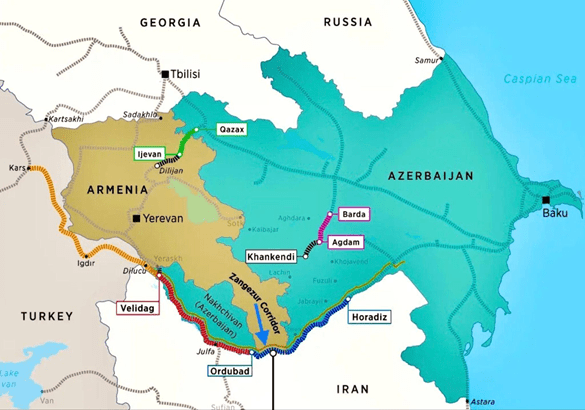
Even though the agreement falls short of offering security guarantees, it reflects a shared understanding that Armenia’s Western pivot needs support. Just recently the US has offered Armenia and Azerbaijan to place the Zanzegur Corridor – a critical link between Azerbaijan and its Naxcivan exclave via southern Armenia.
Yet, despite these promising steps, Armenia’s Western turn is far from guaranteed. The country’s economy is still interlinked with the EAEU. Russian capital still dominates critical sectors like banking, energy and infrastructure. There is a certain dependency on Russia considering tension with neighbouring countries – Turkey and Azerbaijan.
Even so, despite its historical dependence on Russia for security and energy, Armenia has demonstrated that every alliance can be reassessed when national interests and democratic aspirations diverge from authoritarian partners.
For other post-Soviet or geopolitically constrained states, Armenia’s example proves that even under pressure, meaningful integration with democratic institutions like the EU can be pursued without immediate membership, but through values-based reforms.
What is needed is a shift in how the West understands its role in the South Caucasus. Armenia’s shift is not only symbolic, it also reflects the assessment of national interest and identity. The EU and the US must show their support toward these strategic commitments. This includes deeper economic integration, political coordination and security assistance.
Ultimately, the West must realize that Armenia is not a minor case. Its success or failure will echo across the Black Sea region and Eurasia. In that sense, supporting Armenia is not just about solidarity, it is a strategic move.
Yerevan has taken the first step, breaking from ambiguity and choosing a path toward transparency, reform and integration. Whether the West is prepared to walk that path alongside Armenia remains the defining question of 2025.
Bibliography
Avagyan, S. (2025, May 21). Armenia’s EU integration: A strategic pivot amid global geopolitical shifts. European Liberal Forum. https://liberalforum.eu/2025/05/armenias-eu-integration-a-strategic-pivot-amid-global-geop
Hovhannisyan, V. (2023). The prospects of EU-Armenia cooperation: Opportunities and challenges. The Politnomos Journal of Political and Legal Studies, 1(1), 58–73.
Neset, S., Aydin, M., Ergun, A., Giragosian, R., Kakachia, K., & Strand, A. (2023). Changing geopolitics of the South Caucasus after the Second Karabakh War: Prospect for regional cooperation and/or rivalry. Chr. Michelsen Institute.
Wojtasiewicz, W. (2025, February 25). Armenia cautious about rapprochement with the EU and U.S. PISM Bulletin. https://pism.pl/publications/armenia-cautious-about-rapprochement-with-the-eu-and-us
Machitidze, I., Kruessmann, T., & Davitashvili, G. (Eds.). (2021). The “new” geopolitics in the Caucasus: What role for the EU? ibidem Press.


 The Eastern European Review
Leave a comment