
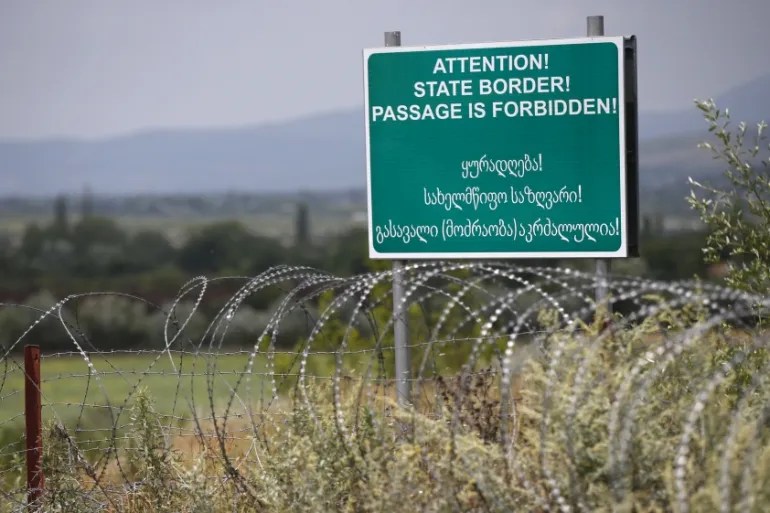
By Tinatin Grdzelishvili
Founder & Editor-in-Chief | BA International Relations Student at Webster University Georgia
July 2025 • 5-Minute Read
Modern conflicts are fought not only through force but also through narratives. As Joseph Nye (2004) notes, “the side with the better story wins.” Narratives are central to achieving lasting success in conflicts and can equally explain their absence. In asymmetric conflicts, where territories can no longer be seized and reorganized by the victor as in conventional wars before the 20th century, persuasive narratives are often required to validate military gains. This also implies that the struggle to win hearts and minds, which has become essential in contemporary conflicts, now targets much broader audiences extending well beyond the physical battlefields. (Hamm & Barroso Cortés, 2024)
The United Nations Security Council passed 32 resolutions reaffirming Georgia’s sovereignty and territorial integrity, officially recognizing Abkhazia as part of Georgia. The question of Abkhazia’s independence remains highly disputed, with separatist advocates pushing for it, while Moscow has played a major role in shaping and manipulating the narrative since the historical ties between the Georgian kingdoms and the Russian Empire. (Kikilashvili, 2023)
According to Beacháin (2025), Georgia’s official discourse on uniting its territory alternates between urging foreign governments to label Abkhazia an “occupied territory” and sporadic efforts to engage Abkhazians directly. Politicians and media often dismiss references to a Georgian-Abkhaz conflict as Russian propaganda, framing it instead as a struggle between Georgia and Russia. State media frequently describes the 1992 events as a “war with Russia” and portrays Abkhazians as mere tools of Moscow, denying their political agency.
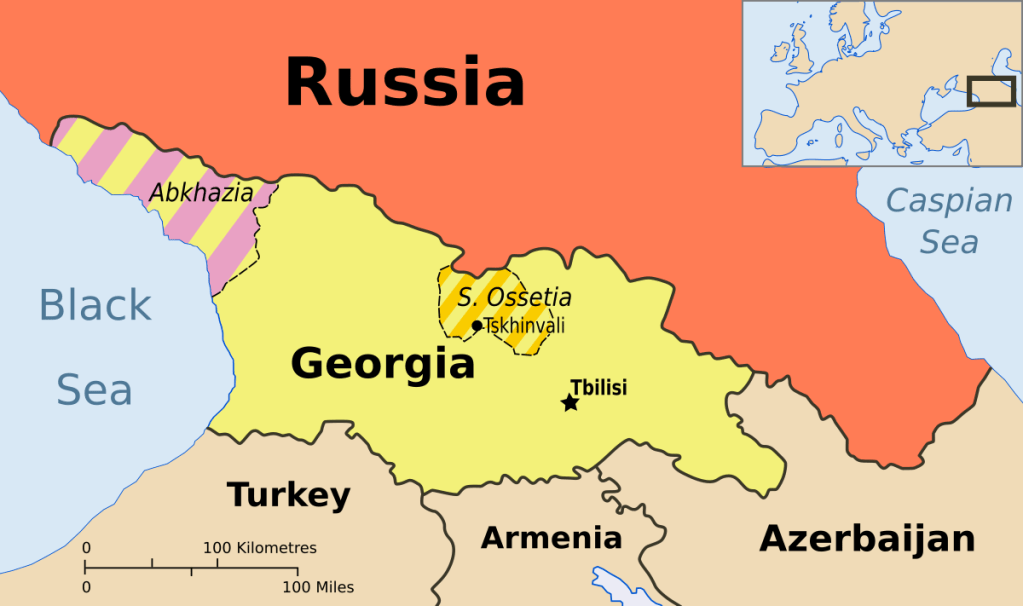
In 2006, nearly 20% of Georgian territory stayed outside central government control, displacing about 260,000 people and fostering illicit trafficking. Georgia’s secessionist regions posed a serious threat to the country’s stability, aggravated by Russian support for the separatists. Moscow’s involvement in these conflicts allowed it to maintain leverage over Georgia, while the presence of Russian military bases further escalated tensions. Both sides remained locked in a dangerous stalemate. (German, 2006)
As stated by Fraser (2022), the Tskhinvali Region and Abkhazia served as testing grounds for Russian disinformation tactics. Russian foreign policy deliberately increased tensions, exemplified by the 2006 referendum, where a majority voted for independence under heavy Russian influence, an outcome rejected by Georgia and the international community. A gradual military buildup and exercises prepared local forces for Russian intervention, justifying the conflict once it began. Russia consistently denied this aggression, violating a 2005 agreement requiring disclosure of weapons and withdrawal from military bases by 2008. Moscow justified its actions by pointing to Georgia’s NATO ambitions but simultaneously obscured the real motives by blaming Georgia for the violence, enlisting figures like Mikhail Gorbachev to present Russia as reluctant to engage in war. (Fraser, 2022)
In the Caucasus, competing narratives have become a critical battlefield that influences foreign policy and impacts national identity. Though Abkhazia and South Ossetia receive little Western attention, Kremlin-backed narratives actively target divided Georgian society, using local authorities and influencers not only in Tbilisi but also in Sokhumi and Tskhinvali. Local authorities in Russian-occupied Abkhazia and South Ossetia often echo narratives similar to those of Georgia’s government. Moscow is intensifying efforts to “Russianize” Abkhazia’s legislation, effectively moving toward annexation. (Kapanadze, 2024)
Narrative warfare is central to Georgia’s fight for legitimacy and sovereignty, shaping global views of its occupied territories and conflicts. Russian-backed narratives undermine Georgia’s position, making the battle over perception as critical as military defense. Engaging in this narrative front is vital for Georgia’s security and international standing. Still, there is hope with stronger communication and global partnerships, Georgia can affirm its identity, counter disinformation and contribute to building a more stable and secure Caucasus.
Bibliography
Beacháin, D. (2025). Courting Europe: Diplomatic Battlegrounds and the Georgian–Abkhazian Conflict. Irish Studies in International Affairs 36(2), 178-218. https://dx.doi.org/10.1353/isia.2025.a962916.
Fraser, C. (2022, November 3). How Russian disinformation tactics were utilised in the context of the 2008 5-day war. Memory and Disinformation Studies. Institute for Development of Freedom of Information (IDFI). https://idfi.ge/en/how_russian_disinformation_tactics_were_utilised_in_the_context_of_the_2008_5_day_war
German, T. (2006). Abkhazia and South Ossetia: Collision of Georgian and Russian interests. Research Programme Russia/NIS. Institut Français des Relations Internationales (Ifri). http://www.ifri.org
Hamm, D., & Barroso Cortés, F. S. (2024). The role of soft power in modern conflicts. Holy Spirit University of Kaslik (USEK) and Universidad Loyola Andalucía.
Kikalishvili, S. (2023). Russian intervention in the Georgian-Abkhazian conflict: A history of tensions and turmoil. Cogent Arts & Humanities, 10(1). https://doi.org/10.1080/23311983.2023.2220216
Nye, J. (21 July 2004). Today, It’s a Questions of Whose Story Wins. Los Angeles Times. https://www.latimes.com/archives/la-xpm-2004-jul-21-oenye21-story.html
Kapanadze, S. (2024, April). Russian Propaganda Narratives in Georgia. GEOpolitics, (Issue No. 05).

 The Eastern European Review


Leave a comment