
By Nino Khatisashvili
Bachelor’s Student in Political Science at Tbilisi State University
August 2025 • 8-Minute Read
The Armenia–Azerbaijan–U.S. agreement has triggered a ripple of concern in Georgia, encapsulated in the colloquial term “FOMO” – fear of missing out. Beneath the casual phrasing lies a serious strategic worry: exclusion from a developing axis that may reshape the region’s transport corridors, security alignments, and diplomatic priorities. This article examines whether Georgia will emerge as a “winner”- leveraging new transit and diplomatic opportunities – or as a “loser,” sidelined from crucial corridors and regional decision-making. In doing so, it assesses the potential implications for Georgia’s strategic role in the Middle Corridor and its broader transitional path toward integration with global markets.
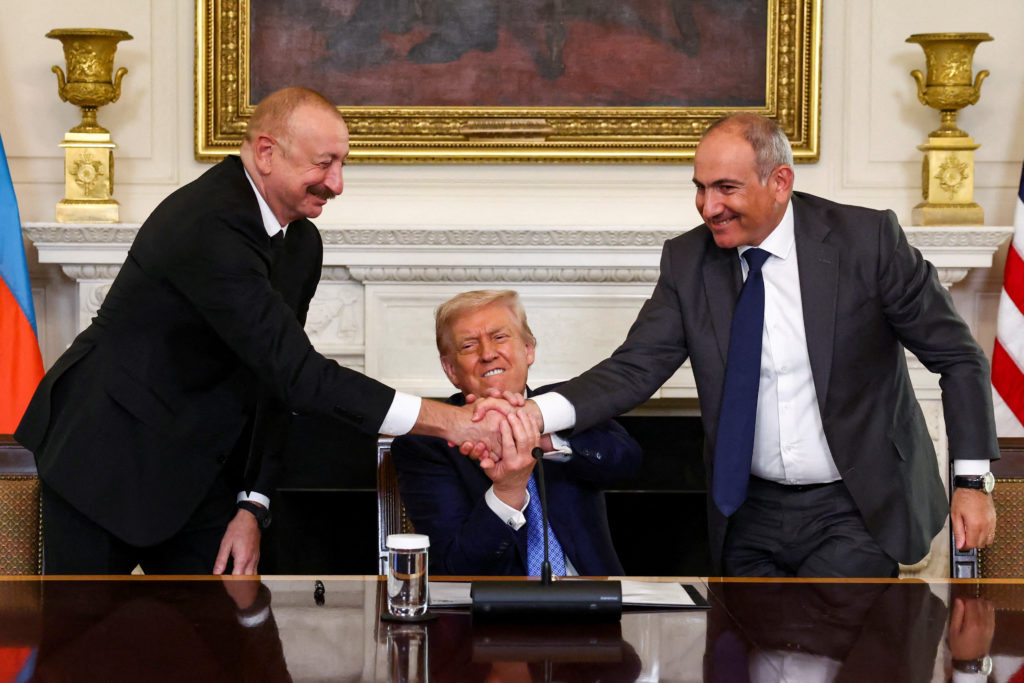
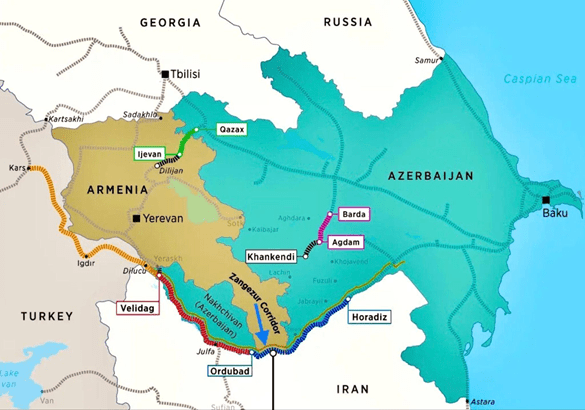
U.S. policy toward the South Caucasus under Donald Trump has been defined by a pragmatic blend of transactional diplomacy and infrastructure-focused engagement. In the wake of the 2020 Nagorno-Karabakh ceasefire, Washington largely ceded the mediation role to Russia, limiting its involvement to humanitarian aid and targeted diplomatic outreach (Washington Post, 2023). However, the recent Armenia–Azerbaijan–U.S. trilateral talks mark a sharp departure from that passive posture, with the White House actively brokering economic and security arrangements designed to outflank Russian and Iranian influence (Reuters, 2025). The linchpin of this renewed U.S. involvement is the proposed transit and connectivity deal – informally dubbed the “Trump Corridor” – which would link Azerbaijan’s mainland to its Nakhchivan exclave via Armenian territory. This corridor, secured under exclusive U.S. development rights, aims to integrate transport, energy, and digital infrastructure in ways that would bind Armenia more closely to Western markets while reducing its reliance on Russia (Eurasianet, 2025).
For Georgia, the stakes are twofold. On one hand, a stable Armenian – Azerbaijani relationship could foster a more secure regional environment, enhancing the attractiveness of the Middle Corridor for European and Asian investors. On the other, if the Trump Corridor diverts trade flows or creates alternative east – west supply chains that bypass Georgian ports and railways, Tbilisi risks losing both revenue and strategic leverage (German Marsall Fund, 2024)
According to Ertoba 2025, the august 8 treaty brokered under former U.S. President Donald Trump between Armenia and Azerbaijan outlined several critical provisions aimed at stabilizing the South Caucasus region. Central to the agreement was the establishment of a comprehensive peace framework to formally end hostilities and resolve the longstanding conflict between the two nations. The treaty also mandated the official dissolution of the OSCE Minsk Group, thereby terminating its mediator role in the peace process. Furthermore, the accord facilitated the signing of multiple economic and energy cooperation agreements with the United States, designed to promote regional development, improve infrastructure connectivity, and enhance trade relations. Importantly, the treaty aimed to diminish Russian influence in the South Caucasus, concurrently bolstering the diplomatic presence and strategic interests of the United States within the region. Since then, Georgia’s future role as a pivotal transit hub will depend on its ability to negotiate with the U.S. and regional partners, diversify its infrastructure, and integrate itself into the emerging geopolitical architecture shaped by American involvement.
Paata Tsagareishvili, Director of the “Transport Corridor Research Center” in Georgia, highlighted that the opening of the Zangezur Corridor would enable Armenia to become a transit country – an ambition long considered unattainable. He warned that this development could result in a significant loss of freight traffic for Georgia’s Middle Corridor, including Armenia’s mineral exports to China and Kazakh wheat shipments to Turkey, which might shift away from Georgian routes. Tsagareishvili emphasized that while the exact impact on freight volumes and Georgian ports remains uncertain until the project’s fate is finalized, the risk of diversion and economic harm to Georgia is substantial (BPN, 2025).
Building on these concerns, Tornike Sharashenidze, a full-time professor and the Head of the MA Program of International Affairs at the Georgian Institute of Public Affairs, (2025) offers a more balanced view. He notes that the Middle Corridor became important mainly after the Ukraine war closed the Northern Corridor, which is likely to reopen after the conflict ends. Even if it doesn’t, the Middle Corridor has only partially replaced it, with most trade shifting to sea routes, which are more profitable. Sharashenidze points out that only about 10-15% of $60 billion worth of raw materials cannot be carried by both corridors combined, plus an additional $15 billion of cargo moving from Europe to Asia. Given the huge investments in pipelines like Baku-Tbilisi-Ceyhan and Baku-Tbilisi-Erzurum, and the long time needed to develop new infrastructure, the Zangezur Corridor cannot realistically replace the Northern Corridor or Black Sea routes. Therefore, despite some risks, Georgia’s transit role and projects like Anaklia remain vital.
While some opposition figures regarded the accords as an opportunity for Georgia and evidence of ongoing Western engagement in the region, many pro-Western Georgians expressed concerns on social media, fearing that the country is once again missing a crucial chance to reduce Russian influence. The following section examines the contrasting narratives presented by Georgian Dream (GD) and opposition leaders concerning the TRIPP route: The Georgian Dream (GD) government expressed strong support and optimism regarding the August 8, 2025 peace accords between Armenia and Azerbaijan, viewing the agreement as a historic milestone for regional stability and economic development. Irakli Kobakhidze, rulling party’s Prime Minister, framed the deal as a “historic moment” for the South Caucasus and praised the leadership of President Donald Trump, President Ilham Aliyev, and Prime Minister Nikol Pashinyan in achieving this breakthrough. The Georgian Ministry of Foreign Affairs echoed this sentiment, emphasizing the accord’s potential to foster sustainable peace and long-term prosperity in the region, while highlighting the United States’ pivotal role in ending the protracted conflict. Similarly, Shalva Papuashvili, GD’s Speaker of the Georgian Parliament, welcomed the deal as a critical step towards reconciliation and a new era of regional cooperation, underscoring hopes for enhanced security and stability through this U.S.-brokered agreement. Collectively, GD narratives position the TRIPP route and the peace agreement as foundational for advancing Georgia’s interests in peace reinforcement, regional integration, and economic opportunity (Civil Georgia, 2025).
The opposition’s response to the August 8, 2025 peace accords and the TRIPP route presents a more critical and cautious perspective. Salome Zurabichvili, Georgia’s fifth president, acknowledged the peace agreement as a significant achievement for the Caucasus, particularly highlighting the overcoming of Russian obstructionism. Giorgi Gakharia, former Prime Minister and leader of the “For Georgia” party, praised the U.S. leadership under President Trump in securing peace but sharply criticized the ruling “Georgian Dream” for sidelining Georgia from shaping the new regional order, attributing the country’s isolation and lack of progress to the current government’s pro-Russian stance. Tamar Chergoleishvili, leader of the “Federalist party” viewed the peace deal as an opportunity to increase American interest in Georgia but stressed that domestic political change is essential for the country to fully benefit. Nika Gvaramia, leader of “Ahali/Coalition for Change”, offered a particularly stark assessment, warning that the TRIPP route signals a geopolitical and economic shift away from Georgia, with Armenia gaining new regional prominence and U.S. military presence in the Zangezur Corridor. He argued that Georgia faces a strategic impasse, as the historic Silk Road transit shifts away from its territory, undermining its exclusive role in the Middle Corridor ( Civil Georgia, 2025).
To sum up, the Armenia–Azerbaijan–U.S. agreement presents both opportunities and risks for Georgia’s strategic role in the South Caucasus. While the peace accords may foster regional stability and economic growth, Georgia faces a significant threat of marginalization from emerging transit corridors. To secure its position, the country must prioritize critical infrastructure projects such as the Anaklia port and the comprehensive renovation of its railway networks, while enhancing connectivity through the Black Sea region to maintain access to global markets. However, what casts serious doubt over Georgia’s ability to capitalize on these opportunities is the current Georgian Dream government’s pro-Russian shift, its authoritarian approach to the rule of law, and trends of “Orbanization” (RadioFreeEurope, 2025). These political developments risk isolating Georgia from Western partners and undermining investor confidence. Therefore, alongside infrastructure and diplomatic efforts, Georgia must urgently restore democratic governance and strengthen the rule of law to regain trust and leverage its geographic advantages effectively. Only through this combination can Georgia avoid marginalization and realize sustainable development within the evolving regional geopolitical landscape.
Bibliography
BPN.ge. (2025, May 16). ზანგეზურის დერეფნის გახსნით სომხეთი ხდება სატრანზიტო ქვეყანა – ეს მისი აუხდენელი ოცნება იყო [Opening of Zangezur corridor turns Armenia into transit country – its unfulfilled dream]. https://www.bpn.ge/article/139074
Civil.ge. (2025, August 10). Georgia reacts to U.S.-brokered Armenia-Azerbaijan peace deal. https://civil.ge/archives/696458
Ebel, F., & Choi, M. (2025, August 8). Trump presides over Armenia-Azerbaijan peace framework, upstaging Russia. The Washington Post. https://www.washingtonpost.com/politics/2025/08/08/azerbaijan-armenia-nagorno-karabakh-trump/
Ertoba . ერთობა (2025, August 10). Georgia reacts to U.S.-brokered Armenia-Azerbaijan peace deal [Facebook post]. Facebook. https://www.facebook.com/share/p/1B9Kh8iUzR/
Eurasianet. (2025, August 8). Georgia, Azerbaijan see surge in transit demand amid Russia’s isolation. Eurasianet. https://eurasianet.org/georgia-azerbaijan-see-surge-in-transit-demand-amid-russias-isolation
RFE/RL. (2023, March 23). Georgian Dream lawmaker Tsulukiani ceases work after controversy. https://www.rferl.org/a/georgia-georgian-dream-pace-tsulukiani-ceased-work/33296055.html
Khatiashvili, N., & Tsiskadze, M. (2024, August 5). The Middle Corridor. German Marshall Fund of the United States. https://www.gmfus.org/news/middle-corridor
Shalal, A. (2025, August 8). Trump announces peace agreement between Azerbaijan and Armenia. Reuters. https://www.reuters.com/world/trump-announces-peace-agreement-between-azerbaijan-armenia-2025-08-08/



 The Eastern European Review
Leave a comment