

By Luka Okropirashvili
BA International Relations Student at Webster University Georgia
November 2025 • 7-Minute Read
In the context of contemporary international relations and the persistent remaking of the global governance system, the rules-based, normalized world order is confronted with a growing stability crisis. The Western world’s geopolitical primacy, formerly framed as universal and immutable, is today undergoing never-before-seen oscillations. These symptomatic processes of fragmentation imply not so much transitive strategic uncertainty as the beginning of a fundamentally new milestone in world history.
At the core of this drastic transformation cycle is the reshuffling of power and influence. No longer in normative modes of unipolarity or bipolarity, international power is increasingly diffused and divided among multiple regions and actors. The latter redistribution and remodeling process ensures fertile ground for rising and middle powers to vocalize strategic claims and challenge long-standing institutions and proven frameworks of international cooperation. For the majority of the states, the historical pivot point in international life is that of peril and possibilities.
In such an active political landscape, non-aligned, asynchronous, and non-traditional alliances play an increasing role in the norm-shaping process and global policymaking. No longer as supplements next to traditional institutions, the newly emergent fractions operate as functional instruments directly contributing to the unfolding of an irreversible trend toward multipolarity. Blending differing priorities and agendas into the international mainstream, such groups widen the limits of global balance and reinforce the development of somewhat new power equilibria.
It is indeed in just such a status quo that the Russia-India-China (RIC) trilateral dialogue format, colloquially referred to as the RIC Troika, has regained centrality as a subject of analysis. Even as the trilateral mechanism was broadly self-limited by internal divergents and geoeconomic limitations, its revival signals broader realignments of Eurasian geopolitics and the growing relevance of the Global South in world affairs.
Genesis and Evolution of the RIC Troika
Russia initially introduced the conceptual framework of the trilateral dialogue of the RIC in 1998. Until 2002, the format was institutionalised with annual recurring meetings between the Russian, Indian, and Chinese foreign ministers. With foresight on the part of then–Russian Foreign Minister Yevgeny Primakov, the RIC was envisaged as a significantly important forum for major Eurasian powers to coordinate, democratize international relations through regionalism, and counter the unipolar hegemonic order being led by the Global North.
In the first decade of the 2000s, the Troika enthusiastically discussed issues of counterterrorism, energy security, and UN Security Council reform. Nonetheless, internal tensions and disagreements persisted due to the absence of mutual trust and historic rivalries between India and China. These tensions came to a boil in 2020 after clashes in the Galwan Valley brought the RIC into an age of stagnation and stasis (Nanda, 2025). Even though India virtually called the 18th foreign ministers’ meeting in 2021, the pace slowed down a while later, and no meeting was held thereafter. This retraction gave rise to relevant doubts about the effectiveness and vitality of the Troika. All the same, evolving global developments have since brought a fresh status quo in which the RIC may yet become newly salient.
RIC in Historical Perspective – Strategic Implications
On May 29, 2025, while speaking at the Perm Conference on Eurasian Security and Cooperation, Russian Foreign Minister Sergei Lavrov declared it was time to revive the RIC Troika while announcing that New Delhi and Beijing reached “an understanding on de-escalation of tensions on their shared border” (The Economic Times, 2025). Considering the international scenario as in flux as it is now, Russia is now seeking to restore the Troika through a combination of rhetorical policy and actual maneuvering. This is as much a situational diplomatic initiative as it is a circumstance-motivated strategic necessity.
In Moscow, facilitating rapprochement between China and India, either through mediation or an exercised soft power cascade, is part of an offset strategy and wider counter-campaign of making up for growing dependence on China, alleviating suffocating pressures of international isolation, and maintaining a status as a supreme regional power. Clearly, positing the RIC as an alternative bloc to U.S.–controlled ones, including NATO, Russia attempts to reassert its overriding exclusive sphere of influence over the Eurasian world.
For Beijing, the RIC is as much a tool of regional diplomacy as it is an instrument of expanding geopolitical clout. It is aligned with Beijing’s foreign policy agenda of contesting U.S. presence in the Asia-Pacific and upholding the tradition of a multipolar international system. It yet leaves a degree of freedom for stabilizing bilateral relations with India without pitting it on multiple fronts.
The Troika presents both considerable challenges and risky opportunities for India. Historic military and security ties with Moscow are key, yet border frictions and mutual suspicions with Beijing remain. Signing a border treaty in 2024 reduced tensions, but mutual suspicions on both sides prevail, particularly regarding Arunachal Pradesh and Beijing’s military partnership with Pakistan (Panda, 2025). The aforementioned list of objective factors complicates India’s ability to handle the RIC.
Yet, India makes an effort to retain a pragmatic foreign policy of diversification and hedging without exclusion, keeping U.S. and QUAD relationships in balance with regional alliances and Russia. This multi-vectoral foreign policy helps New Delhi safeguard national interests, improve the competitiveness of India on the international stage, and effectively regulate historical rivalry with Chinese ambitions.
The Tianjin SCO Summit and the Expanding Architecture of Eurasian Multipolarity
The 2025 Shanghai Cooperation Organization summit, held in Tianjin from August 31 to September 1, marked a pivotal moment in the institutional consolidation of Eurasian multilateralism and in the broader strategic setting surrounding the RIC Troika. Bringing together member states, observers, and dialogue partners from across the continent, the summit adopted a new ten-year development strategy aimed at deepening cooperation in the digital economy, infrastructure connectivity, and regional security coordination. More importantly, the Tianjin meeting underscored how the SCO has become an auxiliary framework for implementing aspects of the RIC agenda through formalized structures and shared policy initiatives.
For Moscow, the SCO serves as a vehicle for legitimizing its regional influence and translating bilateral leverage into a multilateral context, especially in the energy and transport sectors. Beijing views the organization as a complementary instrument for its Belt and Road connectivity goals and as a platform for diffusing its vision of a non-Western governance model across Eurasia. India, meanwhile, engages with the SCO pragmatically, leveraging participation to sustain diplomatic flexibility and pursue issue-based cooperation while carefully avoiding entanglement in China-led institutional dominance.
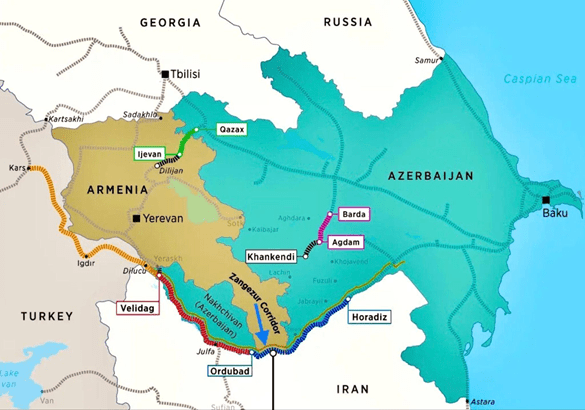
The inclusion and growing visibility of South Caucasus states such as Armenia and Azerbaijan at Tianjin also signal an incremental expansion of the SCO’s geographic and political remit, situating the Caucasus more firmly within emerging Eurasian integration patterns. In this sense, the Tianjin summit not only reinforced the momentum behind multipolar realignments but also provided a tangible institutional arena through which the RIC Troika’s ambitions and tensions are being tested and operationalized across the Eurasian and South Caucasus landscapes.
The RIC Troika Today and the Future of Multipolarity
The RIC Troika carries a major geo-economic weight. Russia is one of the preeminent energy exporters of crucial energy supplies; India is an aspiring democracy with a huge demographic advantage; and China is the planet’s manufacturing and trade powerhouse. The combined economic and military potential of the Troika might ultimately be able to offset U.S. and NATO primacy. Moreover, all three share membership in BRICS, the G20, and the Shanghai Cooperation Organization, with several intersecting formats for interaction and strategic partnership. In that sense, the RIC is an anchor for broader regional convergences as much as a cornerstone for advancing the agenda of greater autonomy of the Global South.
The RIC remains a fragile trilateral alliance, amorphous, irregular, but interesting. The revival of the Russia-India-China conjunction must be perceived as something greater than a strategic preoccupation with immediate pressures. It is one part of the greater and proactive movement of the international system in the multipolar direction. The RIC, with all its advantages and disadvantages and internal tensions, is an attractive initiative in trilateral cooperation between three major powers that are simultaneously partners, competitors, and antagonists.
Its significance is less in institutional influence and more in symbolic and strategic value. In linking Russia’s energy reserves, China’s economic might, and India’s demographic and democratic potential, the Troika is an embodiment of an ambitious non-Western vision of alternative international order – one that reduces dependency on the Western-led order and boosts non-Western actors’ influence. Should it work out, the RIC can serve as a launching ground for wider rising and developing coalitions across the Global South and thereby fortify collective bargaining within platforms such as the G20 and BRICS, as well as galvanize fresh surges of regionalism. Even moderate success in stabilizing India-China relations in the framework will stabilize Eurasia, contain the threat of great-power war, and streamline greater beneficial collaboration on mutual challenges of energy, infrastructure, and regional connectivity.
Yet, past grievances, rival strategic loyalties, and mutually intersecting zones of influence make the Troika vulnerable to mistrust and impasse. Its survival will depend on the political willpower of each of the three powers to compartmentalize conflict, concentrate on pragmatic cooperation, and react adaptively and flexibly to ever-changing global dynamics. At last, the RIC Troika highlights the plasticity of the contemporary world order. Even as the Russia-India-China grouping in itself is incapable of reordering the planet, it highlights a larger trend, namely, the dissolving of unipolarity and the search for new, flexible arrangements better suited for a multipolar age. Either as an operating alliance or as a symbolic counterweight, the RIC’s rise is an indication that the balance of power in the world is no longer fixated, but fluid, and the future of international relations will correspond less and less with uniform settings of great power competition and correspondingly with a diversified landscape of regional cooperation.
Bibliography
Nanda, P. (2025, May 31). Destined to fail? Why RIC alliance that Russia hoped to revive may not succeed. Eurasian Times. https://www.eurasiantimes.com/destined-to-fail-why-ric-alliance-that-russia/
The Economic Times. (2025, May 29). Russia–India–China Troika could be restarted: Russian FM Sergei Lavrov. https://economictimes.indiatimes.com/news/india/russia-india-china-troika-could-be-restarted-russian-fm-sergei-lavrov/articleshow/121731771.cms
Panda, A. (2025, June). The U.S. factor in the Russia–India–China Troika’s revival. The Diplomat. https://thediplomat.com/2025/06/the-u-s-factor-in-the-russia-india-china-troikas-revival/

 The Eastern European Review
Leave a comment