
By Alexia Kapsampeli
November 2025 • 5-Minute Read
One of the most important relationships in the region of the South Caucasus is that of Armenia and Turkey. There is no doubt that the relationship between these countries has been turbulent, and the main issue is the Armenian Genocide. According to Article Two of the UN Convention on Genocide of December 1948, genocide means carrying out acts intended “to destroy, in whole or in part, a national, ethnic, racial or religious group”. There is general agreement about the mass killing of Armenians by Ottoman Turks during World War I. The Young Turks – an officers’ movement that had seized power in 1908 – launched a series of measures against Armenians in the Ottoman Empire, while they had entered the war on Germany’s side in 1914. According to the Turkish propaganda, the Armenians were saboteurs, as they supported the Russians and began a campaign against Armenians. The Young Turks, who called themselves the Committee of Unity and Progress, took measures and deported anyone who was a security threat. Then, a law allowed the confiscation of abandoned Armenian property. There were executions into mass graves, and death marches across the Syrian desert to concentration camps, while a lot died because of exhaustion, exposure, and starvation.
Turkish officials have rejected the term ‘Armenian allegations of genocide’ or the ‘alleged Armenian genocide’ and adopted the term ‘the events of 1915’ (Ozlem Terzi 2016), although historians continue to argue about the events, and there were numerous reports of Turkish atrocities committed against the Armenians.
Another issue with Turkey’s recognition of the events of 1915 as genocide is the fear of having to pay reparations.
As for the total number of Armenian dead, there is a dispute. Armenians say 1.5 million died, while Turkey estimates the total to be 300,000. However, the International Association of Genocide Scholars (IAGS) claimed the death toll was “more than a million”.
In a 2005 letter to Turkey’s Prime Minister Recep Tayyip Erdogan, the IAGS said: “We want to underscore that it is not just Armenians who are affirming the Armenian Genocide, but it is the overwhelming opinion of scholars who study genocide.” Armenians mark the date 24 April 1915 as the start of the Genocide, when the Ottoman government arrested about 250 Armenian intellectuals and community leaders and executed them. Since then, commemorations of the killings are held around the world on April 24 every year.
There have been some efforts to introduce a civil society dimension between the two countries. The Turkish Armenian Reconciliation Commission was founded in 2001 by civilians, mainly retired diplomats and academicians on the Turkish side, with the implicit approval of both governments.
In April 2005, the Prime Minister Recep Tayyip Erdogan suggested the establishment of a history commission and the opening of archives in Turkey and Armenia, as well as in third countries. On the other hand, Armenian President Robert Kocharian mentioned that the lack of official relations and the closed border were the crucial issues. (Ozlem Terzi, 2016, p.91)
Another effort is the 2008 “I apologize” campaign, an online initiative led by a group of Turkish intellectuals to reject the official denial about the issue and to offer an apology. (Aktar 2014) Although the petition provoked strong outcries from Recep Tayyip Erdoğan and Turkish nationalists, more than 32,000 Turks signed it. (Fiona Hill, Kemal Kirisci, and Andrew Mofat 2015)
Nowadays, ninety-one percent of Turks do not believe that the events of 1915 were genocide. On the other hand, the Armenian Genocide remains a primary concern for most Armenians in the homeland and abroad, and they are lobbying for wider recognition in the international community. (Christina Asquith and Audrey Pence 2015)
The next issue between these countries was the Nagorno-Karabakh conflict. After the independence of Armenia from the Soviet Union and the First Artsakh (Nagorno-Karabakh) War, Turkey supported Azerbaijan. The border between Armenia and Turkey was closed in 1993, when Armenian forces captured Kelbajar, along with six other regions around Karabakh. (Krikorian, 2025)
Weeks before the outbreak of the war over Nagorno-Karabakh in September 2020, Turkey had held large-scale military exercises with Azerbaijan. Then, more than 100.000 Armenians, almost the entire population of the area, fled to Armenia. (Górecki 2023)
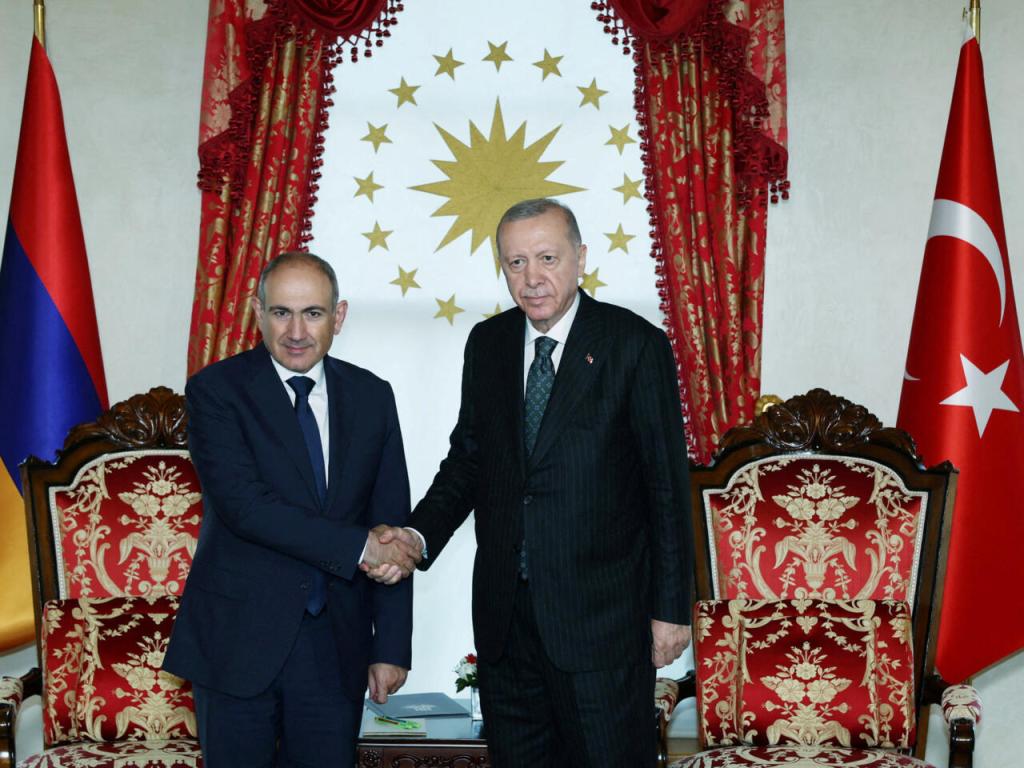
After the Second Artsakh War in 2020 and the loss of the remaining parts of Artsakh (Nagorno-Karabakh), Armenia and Turkey expressed their intention to normalize their relationship.
In 2023, one of Armenia’s two closed borders with Turkey was temporarily opened to allow aid deliveries because of the earthquake in Turkey. (Yacoubian, 2024)
Furthermore, partial normalization has been achieved with the opening of the Turkey-Armenia border for cargo trade and mutual flights.
Two years later, the Armenian government decided to remove a national symbol: Mount Ararat, a symbol of cultural and historical significance to Armenians, despite lying just across the border in Turkey.
This move, effective 1 November 2025, was a symbolic gesture towards Turkey to avoid sending dangerous messages to neighboring countries. However, critics claimed that the national symbol was removed under perceived pressure from Turkey. Actually, Turkish media characterized it as a positive gesture, while officials described this decision as a sign of goodwill. (Khachatyan 2025)
Under these circumstances, it seems if Armenia and Turkey overcome these obstacles, they will normalize their relationship.
Bibliography
Fiona Hill, Kemal Kirisci, and Andrew Mofat (2015) ”Armenia and Turkey: From normalization to reconciliation” https://www.brookings.edu/articles/armenia-and-turkey-from-normalization-to-reconciliation/
Onnik James Krikorian (2025) ”Armenia-Turkey talks advance amid Azerbaijan peace push” https://www.balcanicaucaso.org/en/cp_article/armenia-turkey-talks-advance-amid-azerbaijan-peace-push/
Cengiz Aktar, (2014) “Turkish Civil Society: Driving the Politics of Memory,” Turkish Policy Quarterly, Vol.13, No. 1, http://turkishpolicy.com/article/Turkish-Society-Driving-the-Politics-of-Memory-Spring-2014-977
Kevork Yacoubian (2024) ”What are the prospects of Turkish Armenian normalization? », https://armenianweekly.com/2024/12/10/what-are-the-prospects-of-turkish-armenian-normalization/
”Q&A: Armenia Genocide dispute” (2021) https://www.bbc.com/news/world-europe-16352745
Wojciech Górecki (2023) ”Exodus of Armenians from Nagorno-Karabakh” https://www.osw.waw.pl/en/publikacje/analyses/2023-10-03/exodus-armenians-nagorno-karabakh
Christina Asquith and Audrey Pence (2015) ”Armenian massacre: Why Turkey won’t say the G-word when it comes to Armenians” https://edition.cnn.com/2015/04/24/europe/armenia-turkey-massacre
”Turkey says any U.S. recognition of Armenian ‘genocide’ would further harm ties” https://www.reuters.com/world/middle-east/turkey-says-us-recognising-armenian-genocide-will-further-harm-ties-2021-04-20/
John Kifner ”Armenian Genocide of 1915: An Overview” https://archive.nytimes.com/www.nytimes.com/ref/timestopics/topics_armeniangenocide.html?o
Davit Khachatyan (2025) ”Disarming the Rubber Stamp: Armenia’s Extra Mile for Turkey’s Territorial Integrity” https://opiniojuris.org/2025/09/29/disarming-the-rubber-stamp-armenias-extra-mile-for-turkeys-territorial-integrity/
Ozlem Terzi (2016) ”The influence of the European Union on Turkish Foreign Policy” Routledge, https://www.google.gr/books/edition/The_Influence_of_the_European_Union_on_T/9kSgCwAAQBAJ?hl=el&gbpv=1&dq=armenia+turkey+relations&pg=PA89&printsec=frontcover

 The Eastern European Review
Leave a comment