
By Elene Tvalavadze
Bachelor’s Student of Governance and Social Sciences In Tbilisi Free University
November 2025 • 6-Minute Read
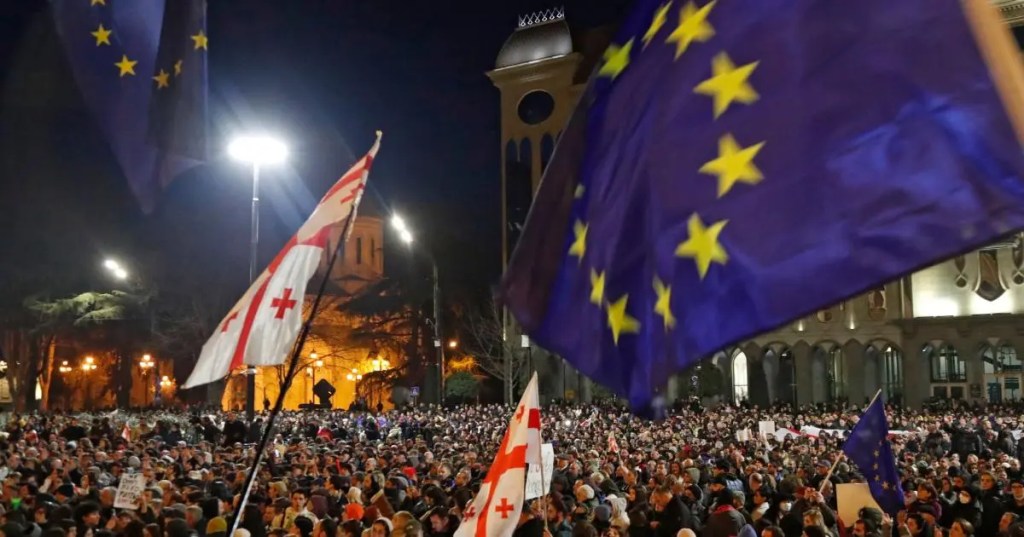
Georgia’s recent political developments must be understood within a broader European context, where the protection of democratic standards and civil liberties continues to serve as a key benchmark for evaluating governance and legitimacy (Council of Europe, n.d.; European Union, 2016). In early October, the country’s ruling party, Georgian Dream, adopted a new law restricting public demonstrations under the justification of “maintaining order” and “ensuring security” (Publika, 2025a). This measure stands in tension with the fundamental principles that define Europe’s democratic and legal order, particularly the freedoms of assembly and expression guaranteed by the European Convention on Human Rights and articulated in the Copenhagen Criteria for EU membership.
Although presented as an administrative reform, the law represents a substantive limitation on civic rights and signals a shift in the relationship between the state and its citizens (Publika, 2025b). It tests the boundaries of how far authority can extend its control within a democratic framework before eroding the very social cohesion it claims to preserve. The law grants police expanded powers to disperse gatherings, introduces stricter penalties for unauthorized protests, and establishes procedural barriers that make spontaneous civic expression nearly impossible. Government representatives justify these measures as necessary to prevent instability and foreign interference, yet the subtext reveals a deeper political fear—fear of criticism, of collective mobilization, and of losing control. The distinction between dissent and disorder becomes blurred, and the notion of public trust gradually gives way to an expectation of submission.
Sociologically, this dynamic can be interpreted through Emile Durkheim’s distinction between mechanical and organic solidarity (Durkheim, 2013). In The Division of Labour in Society (1893/2013), Durkheim explains that modern societies maintain cohesion not through uniformity but through interdependence among diverse individuals and institutions. The Georgian government’s approach appears as a regression toward mechanical solidarity, an attempt to enforce unity through conformity rather than through trust. Such a reversal reflects the weakening of the moral foundation that sustains genuine social order. Placed within the broader European landscape, Georgia’s new protest restrictions mirror a pattern observable across parts of Central and Eastern Europe. Governments in Hungary, Poland, and, more recently, Slovakia have introduced legal mechanisms to limit civic participation and constrain the space for public protest under the rhetoric of security, order, or national sovereignty (Venice Commission, 2022). These developments have been widely debated within the European Union as evidence of democratic backsliding, a process in which formally democratic governments erode liberal norms from within. The EU’s Rule of Law Reports and Article 7 proceedings explicitly state that restrictions on freedom of assembly and association violate the core democratic values enshrined in Article 2 of the Treaty on European Union.
For Georgia, whose leadership consistently identifies European integration as both a strategic and normative goal, the implications are significant. Alignment with European standards is not a matter of symbolism but of institutional credibility. The Copenhagen Criteria and Article 11 of the European Convention on Human Rights define the right to peaceful assembly as a foundational element of democratic legitimacy. By limiting that right, Georgia risks distancing itself from the very political and moral framework it seeks to join. The official narrative of “order” and “stability” thus echoes tendencies already familiar in the European political space, where certain governments conflate the maintenance of authority with the restriction of dissent. Comparative experience shows that stability imposed without participation is inherently fragile. The Venice Commission of the Council of Europe has repeatedly emphasized that democratic resilience depends on open public dialogue and the proportionality of any limitations on civic freedoms. In this respect, Georgia’s legislation diverges from the European normative order, which links legitimacy to citizen engagement rather than to enforced obedience.
Durkheim’s theory helps explain why such control-oriented governance ultimately weakens rather than strengthens the moral fabric of society (Thijssen, 2012). When authority relies on coercion rather than legitimacy, the result is not cohesion but anomie, a condition in which shared values lose their integrative force and individuals withdraw from collective life. Laws that suppress protest do not generate solidarity; they erode the trust upon which democratic systems depend. The appearance of calm achieved through intimidation is therefore deceptive, concealing an emerging disconnection between citizens and the state. Yet Georgia’s civil society continues to demonstrate a strong commitment to democratic participation. Peaceful protests in defense of electoral integrity, environmental protection, and human rights illustrate citizens’ capacity for responsible political expression. The attempt to regulate or suppress such activity reveals not disorder among citizens, but insecurity within governing institutions. In Durkheimian terms, the moral density of Georgian society, its capacity for ethical cohesion and collective responsibility, remains intact, while the state’s normative authority shows signs of decay.
From a comparative European perspective, Georgia’s case reflects a broader regional dilemma: whether political stability should be sought through control or through trust. The European experience demonstrates that democratic endurance relies on dialogue, pluralism, and respect for dissent, not on uniformity. Governments that equate criticism with disloyalty risk both internal alienation and external isolation. For Georgia, the consequences are not merely political but strategic. The country’s credibility as a European democracy will depend on its willingness to align domestic legal practice with the standards articulated by the European Union, the Council of Europe, and the wider corpus of European constitutionalism.
Ultimately, the new protest law symbolizes a deeper contest over the meaning of solidarity in contemporary Georgia. It exposes the tension between a government that seeks unity through restriction and a society that seeks it through participation. Durkheim’s framework clarifies that genuine solidarity arises not from enforced conformity but from voluntary cooperation grounded in mutual respect. By mistaking control for stability, Georgia’s leadership risks reproducing the very instability it claims to prevent. Within Europe’s normative order, democratic legitimacy is maintained not by silencing citizens but by listening to them. The future of Georgia’s democracy and its European trajectory will depend on whether those in power can rediscover that principle.
Bibliography
Council of Europe. (n.d.). European Convention on Human Rights. https://www.echr.coe.int/documents/d/echr/convention_ENG
Durkheim, E. (2013). The division of labour in society (Digital republisher: Digital Library of India; Original publisher: The Free Press of Glencoe, London). http://www.new.dli.ernet.in/handle/2015/126617
European Union. (2016). Treaty on European Union (TEU). EUR-Lex. https://eur-lex.europa.eu/eli/treaty/teu_2016/oj
Honneth, A., & Thijssen, P. (2012). From mechanical to organic solidarity, and back: With Honneth beyond Durkheim. European Journal of Social Theory, 15(4), 454–470. https://doi.org/10.1177/1368431011423589
Publika. (2025). Ocnebis parlamentma miigho protestis shemzghudavi kanonproeqti. https://publika.ge/ocnebis-parlamentma-miigho-protestis-shemzghudavi-kanonproeqti/?authuser=0
Publika. (2025). SJC ocnebis kanonproeqtebi uwyveti protestis chakhshobis miznit gadadgmuli kidev erti nabijia. https://publika.ge/sjc-ocnebis-kanonproeqtebi-uwyveti-protestis-chakhshobis-miznit-gadadgmuli-kidev-erti-nabijia/?authuser=0
Venice Commission. (2022). Tunisia – Opinion on the draft State Property Code, adopted at the 131st Plenary Session (Venice, 17–18 June 2022). Council of Europe. https://www.venice.coe.int/webforms/documents/?pdf=CDL-AD(2022)021-e

 The Eastern European Review
Leave a comment