
By Francesco Palmieri
Bachelor of Arts student in Politics, Philosophy and Economics at Charles University
November 2025 • 4-Minute Read
After the war in Ukraine began in February 2022, Czechia, Slovakia and Poland emerged among Kyiv’s most committed military backers (Reuters, 2023). In the last few years, under the Fiala government, Prague has confirmed total assistance worth CZK 17.4 billion (roughly $4.5 billion) through a Czech-led initiative to supply Ukraine with large-calibre ammunition (Reuters, 2025). Slovakia, under the Heger government in spring 2023, donated its entire fleet of MiG-29 jets and two air-defence systems to Kyiv (The Kyiv Independent, 2025), while Poland has contributed €4.5 billions in military assistance since February 2022 (United24 Media, 2025).
By contrast, Hungary has stood apart from the outset, refusing to provide direct military aid and focusing instead on humanitarian help, contributing almost €300 million through six charity organisations (About Hungary, 2024).
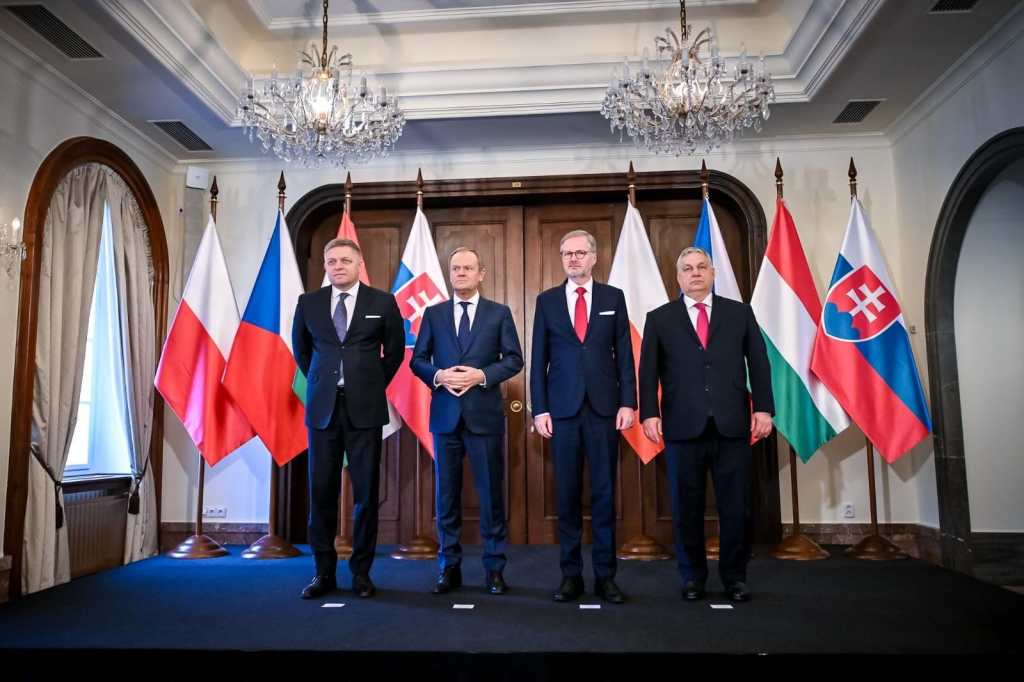
At the beginning of the war, Central Europe therefore spoke with near unanimity: Prague, Bratislava and Warsaw stood firmly behind Kyiv, while only Budapest opted for neutrality. This alignment began to break when Robert Fico became the Prime Minister in Slovakia, ending the Country military assistance shortly after re-taking office in October 2023 (Politico, 2023). Two years later, following Andrej Babiš’s landslide victory in the 2025 Czech parliamentary election, and with Viktor Orbán’s continued rule in Hungary, the “three-plus-one” constellation of early 2022 (three staunch supporters and one outlier) is heading toward a new V3 bloc, that the Hungarian State Secretary Balázs Orbán hope is going to be characterised by a skepticism toward further military support for Ukraine (Politico, 2025).
The V3 support for Ukraine since 2022
Since the start of the war, Hungary has refused to provide any military assistance to Ukraine. From the very first day following Russia’s invasion, Foreign Minister Péter Szijjártó made it clear that Hungary would not send weapons or troops to Ukraine (Reuters, 2022). Moreover, Prime Minister Viktor Orbán has repeatedly called for an end of sanctions against Russia (Bloomberg, 2022) and criticised Western leaders for not taking into account Russian security concerns (Al Jazeera, 2022).
In June 2025, the Hungarian government launched a nation-wide consultation (dubbed “Voks 2025”) on whether Ukraine should begin EU accession talk. The poll, officially non-binding, reported that 95% of roughly 2.3 million respondents opposed opening negotiations (New Union Post, 2025). Orbán later presented these results at the European Council to justify Hungary’s veto on Kyiv’s membership talks (Euractiv, 2025), which remains still in place today.
Energy dependence continues to shape Hungarian policy. In November 2025, Orbán flew to Washington to meet Donald Trump, and secured a one year exemption from US sanctions for using Russian oil and gas (Reuters, 2025), after arguing that Hungary’s pipeline-based energy system leaves it uniquely exposed. Looking ahead, Orbán faces parliamentary elections in 2026, where the appeal of his “peace-first” foreign policy is going to be tested domestically.
Slovakia, under Prime Minister Eduard Heger, was a strong supporter of military aid to Ukraine, donating MiG-29 fighter jets and air-defence systems to Kyiv. This trajectory shifted sharply after Robert Fico and his SMER-SD party returned to power in October 2023. Upon taking office, Fico immediately halted state-funded military aid to Ukraine, but still allowed commercial arms sales. Recently, he reaffirmed that Slovakia is not going to take part in any EU backed programme aimed at financing military help for Ukraine, and that the solution of the war is not on the battlefield (The Strait Times, 2025). According to Politico (2025), Slovakia will not back using frozen Russian assets to cover Ukraine’s military costs, too.
Overall, Slovakia has shifted from a frontline military donor to a closer ally of Hungary’s “Russia-tolerant” posture and humanitarian focused, although more cautious due to its obligations within the EU and NATO frameworks.
Under Prime Minister Petr Fiala (2021-2025), Czechia became one of Ukraine’s most trusted allies in Europe. Prague was able to donate CZK 17.4 billion in military aid to Ukraine since February 2022. The support came through a Czech-led large-calibre ammunition initiative, which combined both government contributions and external donor funds (BrnoDaily, 2025). This announcement of the total aid sum came as the incoming government coalition led by Babiš’s ANO movement criticised the initiative, claiming it lacked transparency and required a reassessment (The Kyiv Independent, 2025).
Following his landslide victory in October 2025, Babiš entered negotiations to form a government with the Motorists and SPD parties, both critical of heavy military support for Ukraine. Nevertheless, President Petr Pavel stressed that he will not appoint key foreign or security-policy ministers who openly oppose Czechia’s position in NATO or in the EU (Politico, 2025). During the transition, the Motorists’ (likely) candidate for foreign minister, Filip Turek, reported that the new government would prioritise humanitarian assistance rather than new military deliveries (Liga News, 2025). However, Ukraine’s Ambassador to Prague indicated that cooperation between Czech and Ukrainian defence industries would continue despite the political change (TVP World, 2025).
Overall, mirroring developments in Slovakia under Robert Fico, Czechia is shifting from frontline military donor to a more humanitarian-focused partner, aligning it closer to Hungary and Slovakia’s current positions.
Conclusion
The trajectory of Central Europe’s engagement with Ukraine has shifted markedly since 2022. What began as a near-unified front, with Czechia, Slovakia and Poland providing military support, while Hungary maintaining a neutral line, has gradually fragmented. The electoral changes in Bratislava and Prague, combined with Budapest’s long-standing opposition to military assistance, have produced a new regional configuration where energy security and sovereignty narratives now outweigh the commitment that defined early wartime support.
This emerging V3 bloc is not, however, a coordinated alliance yet. Rather, these governments are responding to shifting domestic and regional conditions, recalibrating their approach to the conflict. In this environment, Ukraine’s partners may need to look increasingly beyond Central Europe to sustain the level of military and political support required for the long-term future.
Bibliography
About Hungary. “State Secretary: Hungary Has Provided 98.5 Billion HUF to Ukraine since Start of War.” About Hungary, November 25, 2024.
Al Jazeera. “Hungary’s Orban Says EU Sanctions on Russia Have Failed.” Al Jazeera, July 23, 2022.
Bloomberg. “Orban Calls for End of EU Sanctions on Russia, Nemzet Reports.” Bloomberg, September 22, 2022.
Euractiv. “Hungary Holds the Line on Ukraine’s EU Bid Veto after Negative Referendum.” Euractiv, June 26, 2025.
Liga.net. “New Czech Government Does Not Intend to Help Ukraine, Candidate for Foreign Minister Says.” Liga News, November 5, 2025.
New Union Post. “Hungary’s Referendum on Ukraine Accession.” New Union Post, June 27, 2025.
Politico. “Czech Elections: President Pavel, NATO, EU, Cabinet Talks, Andrej Babiš.” Politico Europe, October 5, 2025.
Politico. “Hungary Builds an Anti-Ukraine Bloc with Czechia, Slovakia.” Politico Europe, October 28, 2025.
Politico. “Slovakia Reportedly Won’t Back Using Frozen Russian Assets for Ukraine Military Costs.” Politico Europe, November 9, 2025.
Politico. “Slovakia’s Robert Fico Announces Halt to Military Aid for Ukraine.” Politico Europe, October 26, 2023.
Reuters. “Donors Have Given $4.5 Billion to Czech Ammunition Scheme for Ukraine, Minister Says.” Reuters, October 15, 2025.
Reuters. “Hungary Will Not Allow Lethal Weapons for Ukraine to Transit Its Territory: FM.” Reuters, February 28, 2022.
Reuters. “Trump to Meet Hungary’s Orban, Discuss Russian Oil and Economic Cooperation.” Reuters, November 7, 2025.


 The Eastern European Review
Leave a comment