
By Mariam Davidovi
BA in Governance and Social Sciences, Free University of Tbilisi
November 2025 • 6-Minute Read
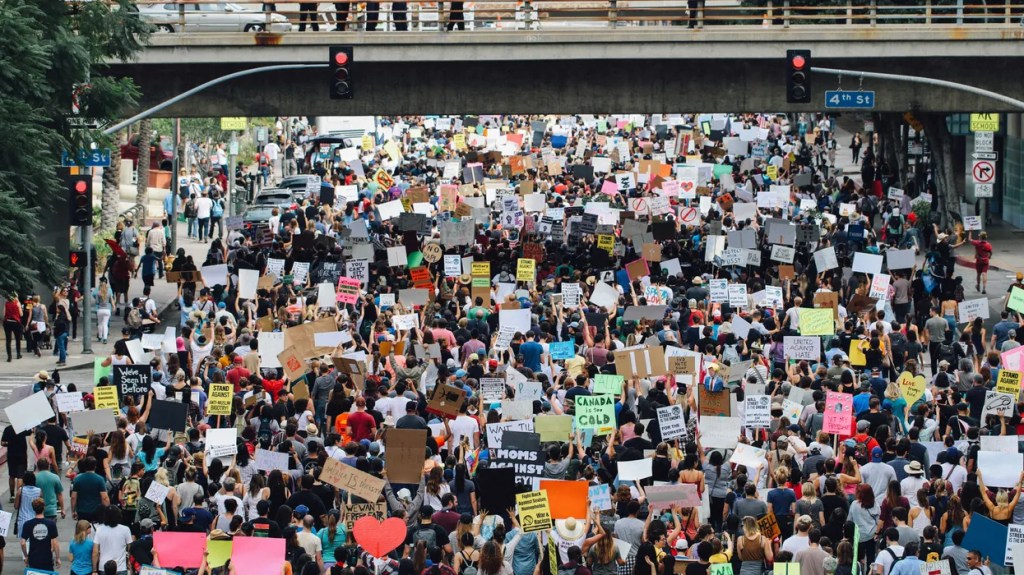
Millions of Filipinos dismantled Ferdinand Marcos’s dictatorship in four days without firing a shot when they flooded Manila’s streets in 1986. Then, In 2003, Georgia’s Rose Revolution toppled Eduard Shevardnadze through peaceful protest. These victories were not anomalies but part of a strategic pattern that offers critical insights for contemporary movements across Eastern Europe and the post-Soviet space.
An analysis of 323 campaigns from 1900 to 2006 by political scientists Erica Chenoweth and Maria Stephan reveals clear evidence: nonviolent campaigns achieve their goals twice as quickly as violent uprisings. While 53% of nonviolent campaigns have succeeded in overthrowing regimes, only 26% of violent campaigns have achieved comparable results (Chenoweth and Stephan, 2011). From Belarus to Central Asia, understanding these mechanisms is becoming a strategic imperative for regions where authoritarian consolidation continues.
Chenoweth’s research identifies a critical threshold: when 3.5% of the population is actively engaged in sustained resistance, political transformation becomes almost inevitable. The 2003 Rose Revolution deployed about 100,000 demonstrators, about 2.5% of the population, who successfully pressured Shevardnadze to resign through strategic positioning and sustained pressure, rather than a large number of people.
This threshold functions as both a mobilization target and a psychological tipping point. When this proportion clearly opposes the regime, security forces face a crisis of calculation: among the protesters may be their own family members, neighbors, or friends. Research shows that nonviolent campaigns attract four times more participants than violent ones – an average of 200,000 versus 50,000 – because they lower barriers to entry (Chenoweth and Chenoweth, 2019).
The post-communist space provides instructive examples. Georgia’s 2003 revolution was successful thanks to a coordinated strategy: students occupied government buildings, protesters surrounded parliament, and opposition leaders maintained strict discipline. When security forces refused to violently disperse the demonstrators, Shevardnadze realized that his position had become impotent.
Ukraine’s trajectory illustrates both opportunities and limitations. The 2004 Orange Revolution overturned fraudulent elections but failed to create sustainable institutions. The 2014 Euromaidan achieved regime change but led to regional fragmentation. The 2020 protests in Belarus mobilized hundreds of thousands of people, significantly more than 3.5% of the population in a country of 9.4 million, but failed to oust Lukashenko. Russian support provided resources and legitimacy unavailable to isolated autocrats, highlighting that even sophisticated campaigns operate within geopolitical constraints.
Strategic Architecture of Nonviolent Campaigns
Chenoweth’s agent-based model, published in PLOS ONE, disaggregates movements into four actors: ordinary citizens, committed activists, regime pillars (economic and social elites), and security forces. The model operates on a fundamental insight: individuals respond more powerfully to what they observe locally than to abstract information. Seeing neighbors join protests exerts greater influence than reading statistics about distant demonstrations.
The decision calculus for citizens involves three variables: grievance against the regime, peer pressure from participating neighbors, and perceived risks of participation. Citizens join when the product of grievance and peer pressure exceeds perceived risk. This explains why some movements achieve rapid mobilization while others stall despite widespread dissatisfaction. If grievances run high but risks appear overwhelming, movements fail to launch. When visible participation reduces perceived risk, demonstrating that numbers provide safety, mobilization accelerates.
The model incorporates protest cycles, active demonstration alternating with rest phases,preventing burnout while maintaining pressure. Individual participants operate on personal cycles, entering and exiting according to their capacities. This creates sustainable momentum: as some withdraw temporarily, others enter, maintaining visible presence without exhausting human resources. Serbia’s Otpor movement in 2000 mastered this approach, organizing daily low-risk actions that normalized resistance while reserving energy for strategic escalations.
Regime durability ultimately depends on security force loyalty. Chenoweth’s framework identifies the threshold at which military and police units refuse orders: when protesters visible to them exceed their individual threshold for participating in repression. This calculation incorporates whether family or friends are among protesters, career implications of backing a failing regime, and moral reservations about violence against unarmed civilians.
Romania’s 1989 revolution illustrates this mechanism. When Timișoara security forces refused to fire on demonstrators, the refusal cascaded through military ranks. Nicolae Ceaușescu’s regime collapsed within days once military support evaporated. Conversely, Syria’s 2011 uprising faced security forces willing to employ extreme violence, sustained by sectarian loyalty and external backing. The contrast demonstrates that security force composition and cohesion significantly influence outcomes.
Eastern European movements developed specific tactics to encourage defection. Protesters in Serbia, Georgia, and Ukraine deliberately fraternized with soldiers, offering flowers, food, and appeals to shared identity. These tactics personalize conflict, making abstract orders collide with the reality of suppressing fellow citizens. When police violence does occur, it often delegitimizes the regime. Ukraine’s Euromaidan demonstrated this: Berkut brutality galvanized rather than dispersed protesters, accelerating the regime’s collapse.
The research yields specific strategic prescriptions. First, movements must prioritize broad mobilization over ideological purity. The diversity that enables reaching the 3.5% threshold proves more valuable than cohesive but narrow coalitions. Georgia’s Rose Revolution succeeded partly because it united students, pensioners, business elites, and rural populations behind minimal demands: honest elections and Shevardnadze’s departure.
Second, systematically target regime pillars/economic elites, bureaucratic apparatus, and cultural institutions. Chenoweth’s model suggests beginning with the least loyal pillars, progressively isolating the regime. In practical terms, this means engaging business communities with economic arguments against instability, appealing to civil servants’ professional interests, and mobilizing cultural figures whose defection carries symbolic weight.
Third, maintain nonviolent discipline. Even isolated violent incidents provide justification for crackdowns that can decimate movements. Ukraine’s Euromaidan initially maintained strict nonviolence, but tactical shifts toward confrontation following police brutality complicated international support and provided pretexts for Russian intervention.
Fourth, build sustainable organizational structures that weather repression and maintain momentum through setbacks. This architecture must balance centralized strategic direction with decentralized implementation. Poland’s Solidarity movement demonstrated this balance: national coordination provided strategic coherence while local cells ensured resilience against targeted repression.
The empirical record establishes nonviolent resistance as strategically superior to armed insurgency. This conclusion rests on rigorous analysis of historical outcomes, not moral arguments. For Eastern European societies navigating authoritarian pressures or external interference, this research offers actionable intelligence.
Yet the 3.5% threshold represents a necessary but insufficient condition. Unity, strategic coherence, security force defection, and international context all matter. Belarus’s 2020 experience shows even well-mobilized movements can fail when these elements misalign. Conversely, Georgia and Serbia demonstrate that modest mobilization can succeed when movements exploit regime vulnerabilities and maintain discipline.
Understanding the strategic architecture of successful campaigns, mobilization thresholds, agent dynamics, pillar targeting, security force calculations, transforms resistance from spontaneous outburst into systematic strategy. In regions where formal political channels offer limited opportunity for change, this knowledge constitutes power accessible to those willing to organize, mobilize, and persist. The question facing opposition movements is not whether nonviolent resistance can succeed, but whether they can master the strategic discipline that history shows it requires.
Bibliography
Chenoweth, E., & Chenoweth, E. (2019). The role of violence in nonviolent resistance: A model of civilian defections. PLOS ONE, 14(9). https://journals.plos.org/plosone/article?id=10.1371%2Fjournal.pone.0269976
Chenoweth, E., & Stephan, M. J. (2011). Why Civil Resistance Works: The Strategic Logic of Nonviolent Conflict. International Security, 33(1), 7-44. https://www.belfercenter.org/sites/default/files/legacy/files/IS3301_pp007-044_Stephan_Chenoweth.pdf

 The Eastern European Review
Leave a comment