
By Tazo Glonti
LL.M. Candidate at Europa-Institut, Saarland University
November 2025 • 5-Minute Read
Moldova entered 2024 facing a paradox: the country’s ruling party publicly committed to EU accession, yet lacked the democratic mandate to pursue the reforms the said accession actually requires. The constitutional referendum that year narrowly passed with just over 50 percent support, by merely 13,596 votes, offering only the thinnest approval of the government’s European trajectory (Verfassungsblog, 2024). Instead of providing the political reassurance the government needed, the result deepened public polarization and left the government exposed. In this environment, high-risk reforms, especially the judicial vetting of judges and prosecutors, became nearly impossible to advance without causing constitutional or institutional repercussions.
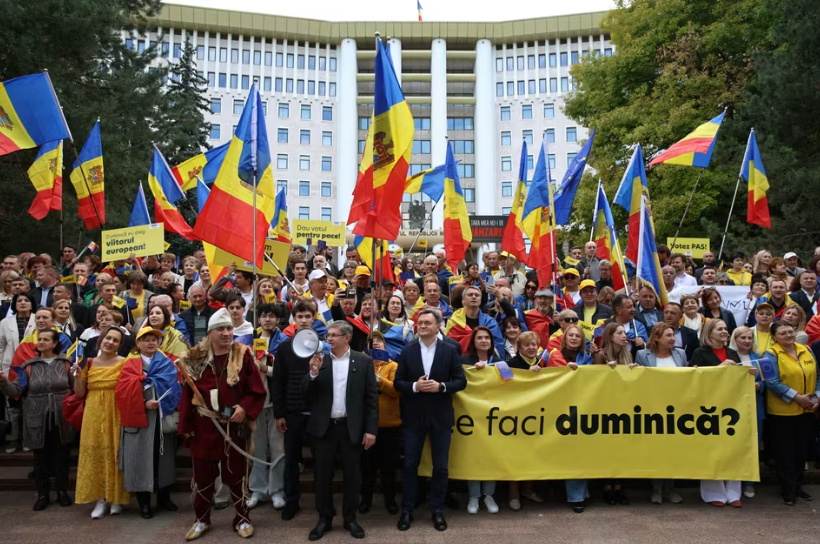
The political picture changed dramatically in September 2025 as the parliamentary elections took place, with the ruling Party of Action and Solidarity (PAS) securing 55 seats and a single-party majority (EU Institute for Security Studies, 2025). This eliminated the need to compromise on the implementation of the judicial reform and, for the first time, equipped the government with the political resources to fully pursue a vetting process and reshape the system instead of applying symbolic changes (EPDE, 2025).
The shift did not go unnoticed by the EU. The 2025 Enlargement Policy Communication explicitly tied the election result to renewed political legitimacy, and the Enlargement Report pointed to concrete judicial reforms (like vetting) as a result of this strengthened mandate, highlighting good progress in reforming the justice sector and identifying Moldova as the candidate country with the strongest overall improvement in Cluster 1 (Fundamentals) (European Commission, 2025b).
This article argues that Moldova’s 2025 parliamentary elections broke the political deadlock created by the weak 2024 referendum mandate and provided the government with the legitimacy and leverage to deepen and accelerate the ongoing judicial vetting process, an institutional development the EU highlighted in the 2025 Enlargement Report as a decisive step forward in the country’s accession path (European Commission, 2025a).
Judicial vetting is effectively a “stress test” for judges. It asks two simple but dangerous questions: where did your money come from, and have you acted honestly? (ethical and financial integrity). For the EU, this is the non-negotiable core of “Cluster 1,” but for Moldova it is an existential threat. It targets the careers of powerful figures who have operated without oversight for years, and naturally, they fight back. This creates a problem: a weak government cannot force these checks without collapsing under the pressure. To survive the inevitable backlash from the system itself, a government needs more than just good intentions, it requires unshakeable political backing to withstand the storm.
The September 2025 election finally provided that shield. By winning an outright majority of 55 seats, the PAS party secured more than just a political victory, they gained the power to stop bargaining. This allowed the government to bypass internal interference and accelerate the vetting of top judges and prosecutors, turning a halted process into an active one. Instead of fearing a government collapse, they could now force the reforms through, proving to Brussels that the changes were not just promised, but irrefutable (EPDE, 2025).
The 2025 Enlargement Report was drafted before its November publication and therefore does not assess reforms undertaken after the September elections. Its significance lies elsewhere. Unlike previous reports, which repeatedly described Moldova’s justice reforms as “initiated” but not operational, the 2025 assessment documents early but concrete movement inside the system: an expansion of integrity evaluations, clearer division of tasks between vetting bodies, and the first measurable output from the institutions tasked with assessing judicial conduct (European Commission, 2025a). These developments were already underway in 2024–2025 but had been progressing slowly and unevenly under the fragile political mandate produced by the referendum.
What makes the 2025 report relevant to the post-election context is not the timing of the reforms it records, but the way the Commission interprets their sustainability. In the accompanying Enlargement Policy Communication, the Commission explicitly links Moldova’s September 2025 election results to a more stable political environment for continuing justice sector reforms (European Commission, 2025b). The documents jointly signal that while the technical progress described in the report predates the election, its continuation and scaling depend on the strengthened mandate secured by PAS.
Seen this way, the 2025 report serves as a reference point: it captures the reforms that Moldova was able to implement even under political uncertainty, and underscores why a more durable majority matters for what comes next. The Commission’s framing aligns with this article’s central claim: the September elections did not just create the progress highlighted in the report, but rather opened the political space for those initial measures to develop into a comprehensive vetting process. Rather than attributing reform outcomes to the election, the report clarifies why the election was necessary for sustaining and deepening them (European Commission, 2025a).
Moldova’s experience offers a significant case study in how judicial reform requires more than legislative drafting; it demands the synchronization of a clear political mandate with specific EU rule-of-law benchmarks. The post-election consolidation of power enabled the advancement of complex institutional reforms, particularly in regards to vetting and governance, that present a different set of challenges in the Georgian context. For Georgia, the value of the Moldovan example lies in the clear link between political legitimacy and technical implementation. The lesson is not about direct imitation, but about the fundamental structure: ensuring that judicial checks are rigorous and that reform commitments remain tied to EU standards, regardless of domestic political shifts. Ultimately, Moldova demonstrates that successful EU integration transforms judicial reforms from a mere technical obligation into a central strategic priority.
Bibliography
European Commission. (2025). 2025 Enlargement Report: Moldova.
https://neighbourhood-enlargement.ec.europa.eu
European Commission. (2025). 2025 Enlargement Policy Communication.
https://neighbourhood-enlargement.ec.europa.eu
EU Institute for Security Studies. (2025). Moldovan parliamentary election: Chisinau has dodged a bullet—for now.
https://www.iss.europa.eu/publications/commentary/moldovan-parliamentary-election-chisinau-has-dodged-bullet-time-dangers
Verfassungsblog. (2024). Three takeaways from the nearly failed EU referendum in Moldova.
https://verfassungsblog.de/three-takeaways-from-the-nearly-failed-eu-referendum-in-moldova/
European Platform for Democratic Elections (EPDE). (2025). Moldova’s 2025 parliamentary elections: A test of democratic resilience under hybrid pressures.
https://epde.org/?news=moldovas-2025-parliamentary-elections-a-test-of-democratic-resilience-under-hybrid-pressures


 The Eastern European Review
Leave a comment