
By Anastasija Mladenovska
December 2025 • 6-Minute Read
A Chokepoint No One Expected
When the Lachin Corridor fell silent in late 2023, Armenia’s isolation became starkly visible to the world. What was less visible at the time was that the country’s geography would soon turn it into a critical chessboard square in Eurasia’s unfolding connectivity wars. For decades, Armenia was treated as a peripheral actor, landlocked, blockaded, and geopolitically constrained. The collapse of the Lachin Corridor and the uncertainty surrounding the future of the Zangezur Corridor have unexpectedly placed it at the center of Eurasian infrastructure rivalries. Whoever shapes the future of Armenia’s Syunik province will shape not only the country’s sovereignty but also the flow of goods and influence across the Black Sea–Caspian axis (Caspian Policy Center, 2023).
Corridors as Instruments of Power
Transport corridors are not neutral infrastructure; they are instruments of leverage and control. History is full of examples where routes have been wielded as tools of geopolitical pressure: the Berlin Air Corridor during the Cold War became a symbol of power projection, pipelines like Nord Stream transformed energy into a weapon of influence, and Belt and Road corridors enabled China to shape new economic geographies. Armenia’s situation echoes these historical patterns.
The Lachin Corridor, once a humanitarian lifeline for Nagorno-Karabakh Armenians, turned into a political bargaining chip as Azerbaijan blockaded it and Russia failed to enforce its security guarantees. Zangezur could easily follow a similar path. Marketed as a trade “unblocker,” it is in fact a contested space where sovereignty, security, and connectivity collide. Whoever controls or guarantees such corridors gains more than economic advantage—they shape strategic options across an entire region (Chatham House, 2023).
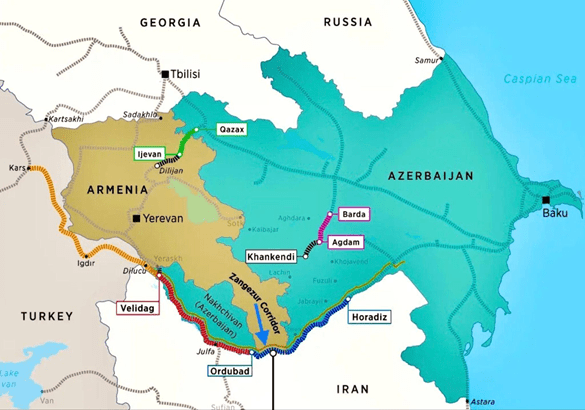
Figure 1. Map of South Caucasus transport corridors, highlighting the proposed Zangezur Corridor linking Azerbaijan to Nakhchivan and Turkey, alongside existing and planned railway and highway routes connecting to Iran, Georgia, and Russia. Source: Caspian Policy Center
The Geopolitics of the Zangezur Corridor
The proposed Zangezur Corridor would link mainland Azerbaijan to Nakhchivan through Armenia’s Syunik province. For Baku and Ankara, this is far more than a trade route; it is a geopolitical prize. Turkey and Azerbaijan envision a pan-Turkic land bridge that bypasses Iran and strengthens Ankara’s role as a Eurasian transit hub.
Iran, by contrast, perceives this plan as a direct threat. Tehran fears encirclement and exclusion from regional trade routes that have long been essential to its north–south connectivity ambitions. Russia, having lost significant leverage after failing to secure Lachin, seeks to reassert itself as a transit guarantor and preserve its role as a regional arbiter (RUSI, 2023). Meanwhile, the European Union frames Zangezur as part of its Middle Corridor strategy, designed to bypass Russian-controlled routes and create alternative pathways between Europe and Central Asia.
At stake is not simply the volume of trade that might flow through this corridor but the power to write the rules of Eurasian connectivity. Zangezur represents a contest over geopolitical architecture, not just logistics.
Armenia’s Existential Dilemma
For Armenia, the debate over Zangezur is an existential dilemma. On one hand, greater connectivity could bring much-needed investment, infrastructure development, and trade opportunities. On the other, corridor arrangements that undermine state sovereignty could deepen Armenia’s dependence on external powers and heighten insecurity.
Prime Minister Nikol Pashinyan’s pivot away from Moscow has weakened the traditional security umbrella that once structured Armenia’s foreign policy. Yet this shift has not been matched by concrete Western security guarantees. Domestically, Armenian society is sharply divided between those who view corridor projects as economic pragmatism and those who see them as potential territorial compromise.
Armenia sits at a chokepoint but lacks a cohesive strategy to turn this position into sustainable leverage. Its strategic ambiguity may buy time, but it does not create agency (Chatham House, 2023).
A Regional Contest With Global Stakes
Control over Zangezur is not merely a bilateral or local matter. It has far-reaching implications for global connectivity strategies. China’s Belt and Road ambitions could be reshaped by new east–west trade routes that either pass through or bypass Armenian territory. Turkey’s east–west corridor would expand Ankara’s influence across Eurasia. Iran’s north–south corridor could be sidelined if it is excluded from key trade flows. And the EU sees this corridor as an opportunity to diversify away from dependency on Russian-controlled infrastructure.
Corridors have increasingly become tools of soft coercion, much like energy pipelines were two decades ago. What happens in Syunik will reverberate across Eurasian trade, energy, and security networks. For context, see analyses from Chatham House and RUSI on these regional power shifts (Chatham House, 2023; RUSI, 2023).

Figure 2. Map of key transport corridors in the South Caucasus. The red line shows the proposed Zangezur Corridor linking Azerbaijan to Nakhchivan and Turkey, while the blue line depicts the North–South Transport Corridor connecting Armenia with Iran and Russia. The map also highlights the Lachin corridor and key regional transport nodes. Source: Washington Institute for Near East Policy, 2023.
Turning a Vulnerability into Leverage
If Armenia wishes to avoid becoming a passive transit zone, it must act strategically. One key step is to diversify its partners to reduce dependence on any single power, whether Russia, Turkey, or the EU. Armenia could also work to internationalize oversight of corridor arrangements, relying on neutral or EU-backed monitoring mechanisms that could provide a measure of security without direct subordination to a single actor.
Anchoring connectivity in legal frameworks that safeguard sovereignty would help ensure that corridor agreements do not come at the expense of territorial integrity. Building domestic consensus around these strategies is equally crucial, as a unified negotiating position would strengthen Armenia’s hand. Finally, Yerevan should push for multipolar connectivity arrangements rather than exclusive corridors, ensuring flexibility and strategic room to maneuver.
For external actors, this means acknowledging corridor politics as a field of geostrategic competition, not just infrastructure planning (Cooley, 2012; Cowen, 2014).
Corridors Without Guarantees
The silence of the Lachin Corridor was not just the sound of isolation; it marked a deeper shift in the regional order. Corridors built without guarantees do not merely move goods—they move power. Armenia may remain landlocked geographically, but it is no longer geopolitically locked out. Whether it remains a pawn or learns to play the board will determine its future role in Eurasia’s connectivity wars.
The coming years will reveal whether Armenia can transform its chokepoint position into leverage, or whether it will be shaped entirely by the strategies of others. For conceptual grounding on infrastructure as power, see Cowen (2014) and Cooley (2012).
Bibliography
Caspian Policy Center. (2023). South Caucasus transport corridors map. Caspian Policy Center. https://caspianpolicy.org/
Chatham House. (2023). Regional power shifts in the South Caucasus. Chatham House. https://www.chathamhouse.org/
Cooley, A. (2012). Great games, local rules: The new power contest in Central Asia. Oxford University Press.
Cowen, D. (2014). The deadly life of logistics: Mapping violence in global trade. University of Minnesota Press.
Royal United Services Institute. (2023). Russia’s evolving role in the South Caucasus. RUSI. https://rusi.org/
Washington Institute for Near East Policy. (2023). Transport corridors in the South Caucasus. Washington Institute. https://washingtoninstitute.org/



 The Eastern European Review
Leave a comment